Model Architecture: Ethernet
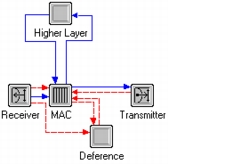
The following figure shows the relevant portions of a typical 10Base2 node model using the process models defined for the Ethernet model suite.
Figure 135: Node Model Structure Surrounding Ethernet
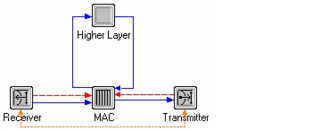
The following figure shows the relevant portions of a typical node model.
Figure 136: Node Model Structure Surrounding Ethernet Hub
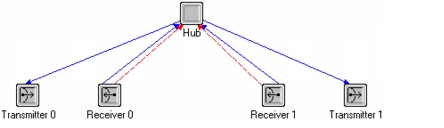
The following figure shows the relevant portions of a typical hub node model.
Figure 137: Node Model Structure Surrounding Ethernet Hub
Process Models: Ethernet
The following table lists the process models used by the Ethernet model suite. Additional details on these process models are provided in subsequent sections.
Table 46: Ethernet Process Models
| name | location | summary |
|---|---|---|
| eth_defer_v2 | Deference Module | Performs carrier sensing and computes the deference variable. |
| ethernet_hub_v2 | Hub Module | Implements the Ethernet hub functions such as collision detection. |
| ethernet_mac_v2 | MAC Module | Performs media access control for the Ethernet interface in a 10BaseT, 100BaseT, or 1000BaseX configuration. The module can operate in either half or full duplex mode, and if operating at gigabit ethernet speed, can have frame bursting either enabled or disabled. |
| eth_mac_v2 | MAC Module | Performs media access control for the Ethernet interface in a 10Base2 configuration. |
| eth_sink_v2 | Higher Layer Module | Provides a simple example of higher-layer interfacing with the Ethernet MAC protocol. The process simply discards arriving packets. |