Model Attributes
All of the RPG nodes have an “RPG Traffic Generation Parameters” attribute that is used to specify the characteristics of the self-similar traffic. Clicking in the Value field of this attribute opens up the RPG Traffic Generation Parameters Table, which is used to specify the traffic’s arrival process, packet size, destination, and start time. A source can generate self-similar traffic using one or more arrival processes. To use more than one arrival process, specify each process in a separate row of the RPG Traffic Generation Parameters Table.
Figure 442: RPG Traffic Generation Parameters Table
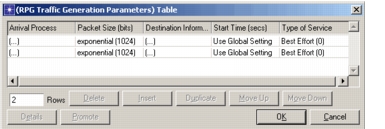
The main RPG attributes are described below:
-
Arrival Process: Specifying the arrival process allows you to choose the fractal point process (FPP) which best describes the self-similar traffic that you are modeling. The Arrival Process attribute is a compound attribute that is composed of several sub-attributes. Since different FPPs require different input parameters, certain sub-attributes will not apply to some arrival processes. Choosing an arrival process from the pull-down menu sets default values for the process’ sub-attributes; you can then view or modify these values by selecting Edit from the Arrival Process attribute’s pull-down menu. A default value of N/A indicates that the sub-attribute is not used for the given arrival process and should not be modified. For example, since the Source Activity Ratio sub-attribute is only used with the ON-OFF arrival processes, its value is set to N/A for all of the other arrival processes.
Figure 443: Arrival Process Table
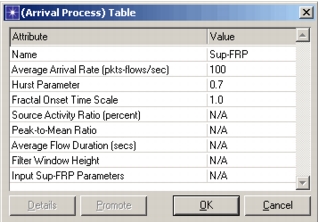
Note that although it is possible to change the arrival process by editing the value of the Name sub-attribute, it is recommended that you use the main Arrival Process attribute (in the RPG Generation Parameters Table) instead. Altering the Arrival Process attribute automatically resets the default values, whereas altering the Name sub-attribute does not.
The main Arrival Process sub-attributes are described below:
-
Average Arrival Rate: defines the average arrival rate for the aggregate traffic that is generated by all sources of the arrival process. The unit used for the arrival rate depends upon the particular arrival process being used. The Sup-FRP process and all three ON-OFF processes are defined in packets/sec, while the flow-based FSNDP processes are defined in flows/sec.
-
Hurst Parameter: defines the Hurst characteristic of the self-similar traffic source. The Hurst characteristic determines the shape parameter for the Pareto distribution and is one of three main indicators of the traffic’s self-similarity.
A second Hurst parameter is used with the H-FSNDP and the F-FSNDP-FF arrival processes. In this case, the first Hurst Parameter is used for the flow duration input parameter of the Pareto distribution, while the second Hurst Parameter is used to determine the interarrival time of the flows. This second Hurst parameter is specified in the Input Sup-FRP Parameters compound attribute, which is described below.
-
Fractal Onset Time Scale: the fractal onset time scale is used with the Hurst characteristic to determine the location parameter for the Pareto distribution. Like the Hurst characteristic, the fractal onset time scale is one of the main indicators of the traffic’s self-similarity.
-
Source Activity Ratio: defines the percentage of time that at least one of the independent ON-OFF traffic sources is active. This attribute is not used for other traffic sources (such as flow-based sources).
-
Peak-to-Mean Ratio: defines the ratio of peak traffic (that is, bursts) over the mean traffic rate, which is defined in the Average Arrival Rate attribute. The Peak-to-Mean Ratio attribute is used only with the ON-OFF arrival processes.
-
Average Flow Duration: defines the average duration of the flow for flow-based arrival processes. This attribute is not used in other, non-flow-based, arrival processes.
-
Filter Window Height: defines the mean packet generation rate within a flow. This attribute is used only with flow-based arrival processes.
-
Input Sup-FRP Parameters: this compound attribute is used to specify the Hurst and fractal onset time scale parameters for the Sup-FRP process that is used as the flow arrival process by the F-FSNDP processes (that is, the shot-noise processes with fractal flow arrivals). The other arrival processes do not use this attribute.
-
-
Packet Size. The packet size is specified using a probability density function (PDF). Varying the packet size or the average arrival rate (described above) will modify the amount of traffic generated by the self-similar traffic source.
-
Destination Information. This attribute is used to specify the destination node of the traffic generated by the arrival process. The Destination Name is specified using either the node’s name, its IP Address, or its MAC address. The Ethernet RPG station,
ethernet_rpg_station, can send self-similar traffic to another Ethernet RPG station only; it cannot send self-similar traffic to RPG workstations that use theppp_rpg_wkstnorethernet_rpg_wkstnnode models. Similarly, RPG workstations,ppp_rpg_wkstnandethernet_rpg_wkstn, can send self-similar traffic only to other RPG workstations (but not ethernet RPG stations).The flow-based arrival processes allow you to send all of the generated traffic to either one node or several different nodes. If all of the traffic generated by the arrival process is destined for only one node, use the default value of 100 for the % Traffic attribute. To distribute the generated traffic to several different nodes, specify each destination in a separate row of the Destination Information Table. In the % Traffic column of the table, specify the amount of traffic that should be directed to each node as a percentage of the total traffic generated by the arrival process.
For non-flow-based arrival processes, only the first row of the Destination Information Table is used and so you cannot use the method described above to distribute traffic among different nodes. To achieve the same functionality for a non-flow-based arrival process, click Duplicate in the RPG Traffic Generation Parameters Table to create another row, then modify the Destination Information of the second row.
-
Start Time. This attribute is used to specify when the arrival process starts generating traffic. The default value of Use Global Setting sets all of the arrival processes (for every node in the network) to begin traffic generation at the time specified in the RPG Start Time simulation attribute. You can set a particular arrival process to start at a different time by specifying the desired time in its Start Time attribute.