xDSL Models
Model Scope and Limitations
The xDSL models allow you to model present-day DSL access capabilities and to determine maximum data rates based on link lengths. You can find these models in the "xDSL_toolkit" object palette. Model features include:
- Generic models adapted to comply with ADSL G.lite standards.
- A generic xDSL_adv link model that allows you to model other DSL standards. To do so, derive a new link model and set the Data Rate attribute to match the DSL technology you are studying.
- All DSL links generate warnings to the simulation log if the link length conflicts with the data rate (based on available values).
- Vendor-specific DSLAM (DSL Access Multiplexer) and DSL modem models.
- Upstream and downstream links for running ADSL over ATM and IP.
Ensuring Proper Port Connectivity
xDSL supports different data rates in the upstream and downstream directions. You should use simplex links to model such asymmetric data rates. For the models to work properly, the upstream and downstream links must be connected to the same node port. You can ensure this by connecting each upstream-downstream link pair in tandem.
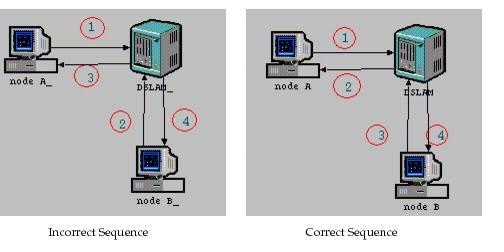
The following figure shows correct and incorrect connection sequences. Assume that you want to connect node A and node B to a DSLAM (DSL Access Multiplexer) using xDSL links. To ensure proper port connectivity, you should connect the downstream and upstream links between Node A and DSLAM before you connect Node B and DSLAM. Using the incorrect sequence will generate error messages during simulation; reconnecting the nodes in the correct sequence eliminates these error messages.
Figure 302: Sequence for Connecting Two Nodes Using Simplex xDSL Links