Model Architecture
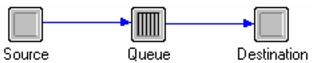
The following figure shows the relevant portions of a typical node model using the process models defined for the Pro/Q model suite.
Figure 1: Node Model Structure Surrounding Pro/Q
Process Models
The following table lists the process models used by the Pro/Q model suite.
Table 1: Queuing Process Models
| name | location | summary |
|---|---|---|
| acb_fifo | Queue Module | Active, concentrating, bit-oriented first-in first-out queuing process model. |
| acb_fifo_ms | Queue Module | Active, concentrating, bit-oriented, multi-server first-in first-out queuing process model. |
| acp_fifo | Queue Module | Active, concentrating, packet-oriented first-in first-out queuing process model. The acp_fifo process model implements a queuing discipline closely resembling the acb_fifo discipline. The difference between these two models is that acb_fifo computes the service delay for each packet based on the number of bits that it contains, whereas acp_fifo uses the same constant service delay for all packets. Therefore, the service rate attribute of acp_fifo is a packet processing rate specified in units of packets/sec, and is independent of the packet lengths. |
| pc_fifo | Queue Module | Passive, concentrating, first-in first-out queuing process model. |
| pc_lifo | Queue Module | Passive, concentrating, last-in first-out queuing process model. The pc_lifo process model implements a queuing discipline closely resembling the pc_fifo discipline. The pc_fifo discipline forwards all packets on a first-in-first-out basis, meaning that packets exit the queue in the same order in which they enter. In contrast, pc_lifo forwards the most recently arrived packet ahead of earlier arrivals that may still be waiting in the queue, essentially implementing the reverse behavior of pc_fifo. This is accomplished by inserting newly arrived packets at the head of the queue, rather than at the tail as is done in pc_fifo. |
| pc_prio | Queue Module | Passive, concentrating, priority queuing process model. It forwards the highest priority packet in the queue first. |
| pf_fifo | Queue Module | Passive, flow through, first-in, first-out queuing process model. pf_fifo inserts received packets into the subqueues which correspond to the streams over which the packets arrive. In other words, a packet arriving on input stream j is placed in subqueue j, and eventually forwarded on output stream j. Hence, the characterization of this model as flow-through. pf_fifo implements a queuing discipline closely resembling the pc_fifo discipline, except that pc_fifo concentrates all received packets on one output stream. In contrast, pf_fifo queues packets arriving on different input streams separately and then forwards them separately, in essence implementing a "bundle" of first-in-first-out queues within one module. This is accomplished by always maintaining an equivalence between input stream indices, output stream indices, and subqueue indices during each packet operation. |
| prq_fifo | Queue Module | Passive, requeuing, first-in first-out queuing process model. It accepts packets from the queue's input streams 0 and 1. Packets arriving on input stream 1 of the queue are treated as requeued packets and placed at the head of the queue. |